Most people will plan or renovate a kitchen sometime in their life. offers you some useful tips to help you plan your kitchen. Even if you are not planning to design and build your kitchen, some of the following tips will help prepare you for a discussion with a professional kitchen planner.
In the following section we mainly make use of centimetre measures. This is because most metric tape measures use centimetres and because many kitchen dimensions are usually expressed using cm. You might prefer to work in millimetres or metres but part of the versatility of the metric system is the ability to convert using factors of 10 or 100.

The starting point in planning a kitchen build or renovation is to be very clear about what you need. A simple checklist is:
Open Plan Kitchens
You are unlikely to have unlimited freedom to do what you want. You will have physical and budgetary constraints. A simple checklist is:
In order to get an efficient kitchen layout it is important to know what tasks are most frequently done and to imagine what journeys around the kitchen are needed to complete a task.
For tasks you do frequently it is important to ensure that the different work places are sufficiently closely located. A study carried out by Cornell University in the 1950s established the notion of the ‘work triangle’ based on many tasks requiring going to the fridge, cooker and sink. Your tasks may be different, for example going to the freezer, microwave oven and dishwasher but the principle of thinking through your tasks remains equally important.
Religion & Community Kitchen Design
It makes sense to use metric when planning a kitchen because kitchen units and domestic appliances are designed in standard metric sizes. If you do your planning in feet and inches you are likely to get muddled and have an ill-fitting kitchen.
Kitchen cabinets are usually 60 cm deep and have widths that are multiples of 10 cm or 15 cm. This sizing is illustrated by the base units shown below.
Drawer units are usually offered in a variety of widths. Larder units are usually 30 cm wide and appliance units 60 cm wide.
How To Design A Kitchen: The Complete Technical Guide
If you have a room less than 180 cm wide you cannot comfortably use standard 60 cm deep units. Some manufacturers offer 50 cm deep units but they may be difficult to combine with appliances.
Most unit doors open up to a maximum of 60 cm. Dishwashers doors usually open by 60 cm and oven doors usually about 50 cm.
Between runs of kitchen units should be a minimum of 120 cm. If more than one person is working in the kitchen
How To Design A Kitchen
Is 90 cm, although this will not necessarily be ideal for everybody. Ensure that the elbow height is a few centimetres above the worktop height for the main kitchen user. This helps make tasks like chopping comfortable. If the main user is very tall consider using an enlarged plinth to ensure comfort. Similarly a very short kitchen user ideally requires a lower plinth to reduce the height of the worktop.Part 1 of the kitchen design series looked at how to develop the brief for your kitchen design, including the type of questions you need to be asking the client. We also looked at different layouts, along with the work triangle.
In Part 2 we will look at standard kitchen sizes, along with some really useful and important rules of thumb that will help you design a practical and functional kitchen.
Kitchens units, appliances and worktops come in standard sizes. These sizes allow for consistency throughout the industry and are a very economical options compared to the requirement of bespoke units at random measurements.
Oak Frame: Building Regulations Detail And Applications
The following table shows coordinated dimensions for kitchen units. The height of worktops should be adapted to suit the height of the user and can vary between 850mm – 950mm – generally speaking 900mm is most common.

There are some fundamental design principles when it comes to planning your kitchen that should be considered. These rules of thumb should help you avoid potential awkward spaces, and poor functionality.
Ensure there is at least 400mm clearance between a kitchen door and the nearest units. This essentially means allowing for 1200mm between the units and the wall with the door.
How To Design An Outdoor Kitchen: Layout Options, Materials And Must Have Features
If you are planning a narrow galley style kitchen, and the room is less than 1800mm wide, you cannot comfortably use a standard 600mm deep unit. You may need to use bespoke (however this would affect appliances) – or reconsider your design.
Allow a minimum 1200mm clearance between runs of units. Most doors open up to around 600mm, i.e. dishwasher, oven door, unit door so a minimum of 1200mm will allow people to pass when then doors are open.
Allow for at least 400mm clearance between the worktop and wall mounted cupboard, to ensure there is sufficient working space below the cupboard on the worktop.
How To Remodel A Kitchen
If someone is to walk past, a distance of 1100mm should be provided. For a wheelchair to comfortably move past the seated diner a distance of 1500mm should be provided.
Allow a minimum of 300mm either side of the hob to ensure suitable work space either side of the cooking area. Also ensure that there is a non combustable surface above the hob and a clearance of at least 600mm.
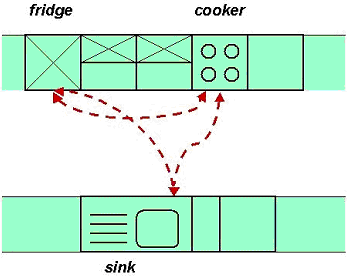
Your kitchen should not be a main thoroughfare to the rest of the house. Make sure traffic does not cross the kitchen work triangle.
Do I Need Planning Permission For A Kitchen Extension?
The sink should ideally be positioned in the centre of the work triangle as it is the most used area of the kitchen.
When positioning your dishwasher, ensure it is at least 500mm from a corner, to allow loading from both sides. Also ensure there is standing space in front of the dishwasher for unloading.
A minimum of 400mm is required beside an oven to be used as a set down space. The same goes for a microwave.
How To Plan Your Kitchen Extension
Ideally a minimum of 400mm worktop space should be allowed for on the door opening side of the fridge for setting down items.
In Part 3 of the Kitchen Design series we will look at designing for accessibility. This will include loads of helpful tips and ideas to make your kitchen design wheelchair user friendly, work better for people with disabilities or the elderly. Check back soon – this one is going to be really helpful.
Share the Knowledge! Kitchen Design Tips - Rules of thumb and standard sizes - all you need to know Click To Tweet

Restaurant Kitchen Design Hacks For An Efficient And Thriving Business
How to Write an Architecture Dissertation 101 In this post we will explore how to write an architecture dissertation, but first… What is an architecture dissertation? The architecture dissertation (or thesis) is an opportunity to demonstrate the...
Free Tree Photoshop Download - Set 11 We are thrilled to present another Photoshop Download set: Free Tree Photoshop Download - Set 11 Are you an architecture student or a professional architect seeking to enhance your designs with stunning tree elevations? Well, look...
New Details This month the team at Detail Library have published a great new set of flat roof details! This detail set demonstrates a variety of flat roof and pitched roof arrangements, including I-joist flat roof details, timber frame green roof details, exposed...
Do You Need Planning Permission For An Outdoor Kitchen?
I have curated a list of some of the tools and resources I would strongly recommend for anyone studying or working in Architecture.
We use cookies to personalise content and ads, to provide social media features and to analyse our traffic. We also share information about your use of our site with our social media, advertising and analytics partners who may combine it with other information that you’ve provided to them or that they’ve collected from your use of their services.Accept Reject Read More
This website uses cookies to improve your experience while you navigate through the website. Out of these cookies, the cookies that are categorized as necessary are stored on your browser as they are essential for the working of basic functionalities of the website. We also use third-party cookies that help us analyze and understand how you use this website. These cookies will be stored in your browser only with your consent. You also have the option to opt-out of these cookies. But opting out of some of these cookies may have an effect on your browsing experience.
A Beginners Guide To Commercial Kitchen Design
Necessary cookies are absolutely essential for the website to function properly. This category only includes cookies that ensures basic functionalities and security features of the website. These cookies do not store any personal information.

Any cookies that may not be particularly necessary for the website to function and is used specifically to collect user personal data via analytics, ads, other embedded contents are termed as non-necessary cookies. It is mandatory to procure user consent prior to running these cookies on your website.We use cookies to ensure we give you the best experience on our website. You can find out about our cookies and how to disable cookies in our Privacy Policy. If you continue to use this website without disabling cookies, we will assume you are happy to receive them. Close.
A technical guide with everything you need to know about how to design


0 comments:
Post a Comment