There are six basic types of kitchen layouts: Island, Parallel, Straight, L-Shape, U-Shape, Open, and Galley. The L-Shaped kitchen is most suited to homes that do not need too much worktop spaces while the galley shaped kitchen is suitable for small homes. Here are the six basic types of kitchen shapes you can choose from before finalising that master kitchen interior plan! Choose wisely; this is going to be the heart of your home for many years to come.
With large kitchen spaces becoming the norm in urban households, island modular kitchen designs are all the hype. Spread out over the entire kitchen area; an island-shaped kitchen accommodates all functionalities in a sophisticated manner. It allows for a variety of comfort options to the host and guests alike. Kitchen layouts with island give more rooms for kids to play around, do their homework, and ample space makes the kitchen a multifunctional area. It also provides additional storage and is more brightly ventilated.

With the advent of parallel modular kitchen designs, your kitchens need not be a claustrophobic hidden room of your house. Now you can show them off with pride and comfort since this particular style allows enough area for the movement. Light flows steadily through a door or window with this kitchen shape making working and cooking a delight for any home chef.
Big Book Of Kitchen Design Ideas
Classy and old fashioned! But that is what makes straight modular kitchens so convenient and easy to use. This kitchen shape ensures enough space for all your accessories and functional elements. This layout sticks to basics and is a must-have for those who like minimalistic decor, cook and dine hassle-free.
This shape works best for small to medium kitchen spaces. To design an L-Shape modular kitchen, one needs thoughtful planning to keep it clutter-free and organized. Creativity amplifies in an L-Shaped modular kitchen. The L-Shaped kitchen is ergonomically appropriate and facilitates a sensible work triangle for preparation, cooking, and cleaning. This type of kitchen design can be matched to any decor as this layout type requires an excellent floor plan. For an L-shaped design to work, the kitchen must be built at the corner where two walls form a perpendicular angle. Also, one part of the wall must be twice the length of other.
A U-Shaped modular design features three walls and are lined with cabinets and appliances. This type of kitchen is an efficient design that frees up floor space. It is the most practical kitchen layout and provides a lot of space for storage and appliances compared to a U-shaped modular kitchen. The concept of the ‘Golden Triangle’ is a natural fit with a U-shaped modular kitchen as your fridge, sink, and stoves are placed within an arm’s reach. This is a practical use of kitchen space, something which L-shaped kitchens and other galley kitchens might find harder to achieve. The biggest advantage of a U-shaped modular kitchen is the safety factor as it doesn’t allow traffic to disrupt your workflow.
How To Correctly Design And Build A Kitchen
An open modular kitchen is popular among most Indian homes as it blends well with the rest of the house. An open modular kitchen adds volume, especially in modest-sized homes. One beneficial factor about open modular kitchens is you don’t feel isolated from the action in the living room. This kitchen shape allows you to converse with guests as you cook, take part in family activities such as watching television. The open concept kitchen is ideal for small homes as this design makes even the smallest spaces feel spacious.
A galley modular kitchen can be defined by two narrow rows of cabinets facing each other with a narrow walkway in between. The galley layout works well with all kitchen styles, as it enhances safety and efficiency while cooking. This type of kitchen shape can fit several cabinets and house doors or walkways at either end of the run. Tall cabinets run along the wall to store all major appliances. Keep base cabinets in a heavier, darker material, and the upper cabinet in a lighter colour to connect it more towards the ceiling. This will also help reduce the feeling that you are in a hallway. Try concealing the fridge and dishwasher behind cabinet panels to give the space a tidy look.
Before deciding on the layout of your new kitchen, ask yourself a couple of essential questions. What do you like about your current kitchen? What do you dislike about your kitchen? Jotting these answers dow n will help you crystallise on a layout that works best for you. Happy searching!® FREE Encyclopedia of Building & Environmental Construction, Diagnosis, Maintenance & Repair No ChatBot Pledge: The accuracy & trustworthiness of every article or Q&A is researched by human experts.
U Shaped Kitchen Design Guide By Saviesa
This article describes the layout and specifications for accessible kitchens and kitchen work spaces. We cover Accessible kitchen work aisles, passageways. Knee space requirements for accessible kitchens.
Clear floor space specifications for accessible kitchens. Counter & appliance height in accessible kitchens. Storage height, handles, & controls for accessible kitchen design.
We also provide an ARTICLE INDEX for this topic, or you can try the page top or bottom SEARCH BOX as a quick way to find information you need.
Home Juice Business Layout
This article series discusses current best design practices for kitchens and bathrooms, including layout, clearances, work space, and accessible kitchen and bathroom layout, clearances, turning space, grab bars, controls, etc.
We include advice on choosing and installing kitchen countertops, cabinets, and kitchen or bathroom flooring, sinks, and other plumbing fixtures and fixture controls such as faucets. A list of kitchen and bath product manufactures and sources is included.

To make a kitchen fully functional for wheelchair users and other seated occupants requires simple commonsense changes, like placing knobs within reach, as well as more significant changes, such as lowering counters and providing knee space below.
L Shape Kitchen Dimensions & Drawings
The guidelines below, based on ANSI (American National Standards Institute) A117.1 standards, are a good starting point in design, but they should be tailored to the size, reach, and specific capabilities of the occupants.
Clear space at doorways and passageways must be at least 32 inches wide and no more than 24 inches long in the direction of travel. Eliminate any thresholds at doorways.
Walkways with counters or appliances on only one side can be 36 inches wide, but if a walkway turns a corner, as in Figure 6-10 (at left), one leg of the walkway space should be widened to 42 inches for a wheelchair to make the turn.
Viking Outdoor Kitchen Planning Guide
To accommodate a seated user, below-counter knee space should be a minimum of 30 inches wide, 27 inches high in front, and 19 inches deep, with a minimum 9-inch-high toe space, which will accommodate most wheelchair footrests.
To make work centers universally accessible, provide a clear floor space of 30x48 inches or 48x30 inches, centered in front of the sink, dishwasher, cooktop, oven, and refrigerator.

In an accessible (or other) kitchen design layout, clear floor spaces for different work areas may overlap, and the long dimension can include up to 19 inches deep of knee space below counters (Figure 6-13).
Kitchen Layouts Dimensions & Drawings
He optimal height for most seated occupants at counters, sinks, and cooktops is about 32 inches and should be no higher than 34 inches.
In an accessible-designed kitchen you should use open shelving, shelf racks on pantry doors, and drawers or roll-out shelving for easy access (Figure 6-14).
Controls, handles, and door and drawer pulls should be operable with one hand, require minimal strength, and not require tight grasping, pinching, or twisting of the wrists. Lever-action handles work well for doors and faucets. A simple test is to try to operate the controls with a closed fist.
How To Choose The Right Commercial Kitchen Layout
Use a shallow sink mounted at 32 to 34 inches (32 preferred) with the drain in the rear so it does not interfere with knee space (Figure 6-15 below).
The garbage disposal must also be offset so it does not interfere with knee space. A tall faucet and pullout spray attachment are recommended to simplify work at the sink. Locate the dishwasher adjacent to the sink or no more than 12 inches away.
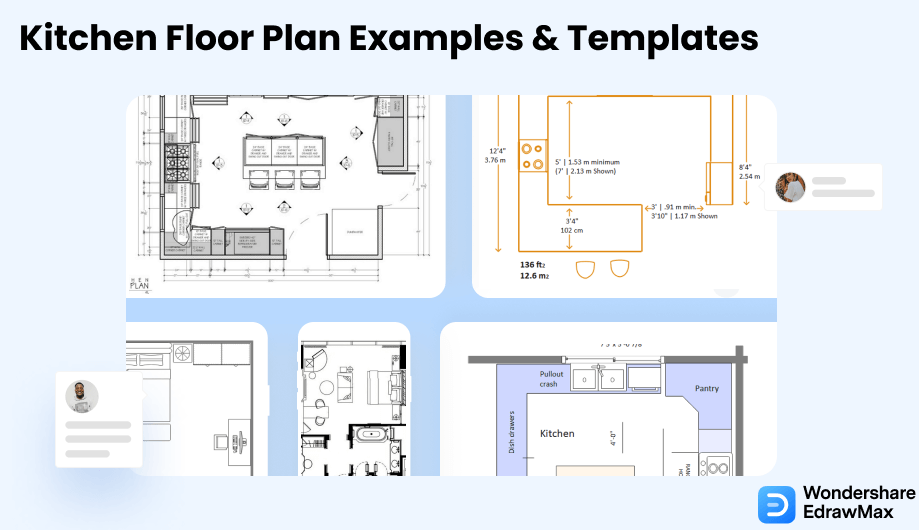
Lighting levels should be up to twice normal levels. Using light-colored floors, walls, ceilings, and counters will help keep all areas well illuminated. Light colors on the insides of cabinets and drawers will help make items more visible.
Kitchen Planning Guide
If possible, place the cooktop and sink on the same wall so users do not have to carry heavy pots across the room. Electric cooktops with a smooth surface and controls on the front work best so the user does not have to reach over the top. Look for units with staggered burners for easier access to back burners.
Use a separate wall-mounted oven, not an under-counter design. An oven with a side-hinged door rather than the usual pull-down style works well.
Side-by-side units with doors that swing back a full 180 degrees are preferable to up-and-down models. Provide at least 18 inches of counter space adjacent to the refrigerator.
Kitchen Design Planning Guide/
Below in the article references section we provide a DOJ article that gives a high-level gloss on the topic of meeting the accessibility requirements for people using a power-driven motorized device


0 comments:
Post a Comment